I had a meeting with my daughter several weeks ago regarding steps to take for publishing my book, Beast Master. We set a publication date and decided on marketing strategies. Of course all the steps that had to be done to get there falls on my shoulders. I set up tasks to do and then promptly went on holidays to ski. The skiing was great, the task completion not so much. Hopefully I’ll catch. up.
Editing – cutting – editing – cutting …..
I have started the edit for In the Blood of the King. At the same time I am reading A story is a Promise by Bill Johnson.
What do the two have in common? The writing process. A Story is a Promise postulates that the writer has to promise the reader a story from the very first sentence. When I think about all the great stories I have read, that is so very true. One of my favourites, Covenants by Lorna Freeman starts “We were lost.” And in that one sentence, the whole book, the whole world the book is in, is summed up. The characters were lost physically, the main character, Rabbit, is lost to himself and the country he lives in is rapidly loosing its identity as it is transformed into something different. The we in the opening sentence is so freighted with meaning that in retrospect I am surprised the word remained printed on the page and hadn’t fallen out of the book!
Oh, to write an opening line like that. What I would give, but I am not Lorna Freeman and who knows how long it took her to get to that simple 3 word sentence. So instead, I have to edit and cut and edit and cut until I am crazy, not knowing if the cutting is good or bad. Ha, there goes the prologue, snip, snip, there goes the beginning of chapter 1. Snip, snip, snip.
Done – In the Blood of the King
Ok, the first draft is finished. I still need to do at least two more revisions, get my beta readers to read it, do more revisions, get an editor to read it, do more revisions etc., etc. You get the picture. BUT that does mean I can actually turn my attention to getting Beast Master published!
Bots and Democracy
My last post talked about bots and bullying. Perrin’s story also talked about how bots affected the democratic process. He mentioned that China was using bots to spread propaganda. This is such a tricky subject. One person’s propaganda is another person’s opinion. Knowing how to discriminate between fact and fiction on the internet is becoming so important. If we swallow whole hog what other’s say, without examining the source and the probability of truth, we are allowing ourselves to be controlled.
There was a time, when people were influenced by those in positions of power to vote according to their desires. If your livelihood was dictated by someone else, they could dictate how you would vote or loose your livelihood. Thus the secret ballot.
The internet poses a similar problem. There are people who have no scruples about sowing disinformation or out right lying to reach their goals. In some cases they think the ends justify the means, but it is for their ends. To make an informed choice you have to have facts, real facts. Sifting fact from fiction is a skill which can be learned and which we must learn if we are to live in a world we want.
Ants – Nope – Bots instead
I was going to do a post on ants, really. They have been everywhere this year, as have rabbits and skunks. Hmm maybe the skunks are because there are a lot of ants. But that isn’t what I am going to talk about.
The Globe and Mail this morning had an interesting article by Benjamin Perrin – “I tweeted about Harper. Then the Twitter bots attacked”. The gist of the article is that bots were used to attack him for a tweet, a quite mild tweet, he did. My first reaction is that once more the dark side of the internet had made itself known. But I, trying to be an informed reader, looked up about bots and realised that, as usual with the internet, bots can be both benign and nasty. http://qz.com/572763/the-best-twitter-bots-of-2015/ has a list of twitter bots which sound really interesting and funny. They are so innocuous and yet lighthearted and fun that I am tempted to follow one or two of them. Perrin’s point, though, is well made. There are bots out there which people can use to indiscriminately attack any one, either through personal targeted abuse or based on keywords the user has selected. As with anything, it is the user which makes something bad and can ruin it for others. (This of course is an opportunity to mutter about guns and how stupid it is not to have some control on them because there are people out there who ought not to have them, BUT I would then be digressing).
When Perrin informed Twitter, they reacted appropriately, ‘vapourising the tweets’. This form of cyber bullying is not just about twitter, or Facebook or Instagram, it will happen wherever people congregate. Anonymity on the internet makes it easier for the bully to swagger his/her way through someone else’s life. Perrin’s point about the victim of the attack may not be someone who can discern that it is an automated attack and the world is not attacking them, only a few, count 1, nasty person, is important. There have been a few high profile cases of teenage suicide because of cyber bullying. Which means we really need to teach everyone, children and adults, how to be informed, sceptical users of everything internet based. That will make it harder for that nasty underbelly of the internet to be effective, not impossible, just more difficult.
Bridges across the ages
We’ve been away for a few weeks. The middle daughter graduated with a PhD in psychology and my husband, her youngest sister and me went to the ceremony. Her older sister, unfortunately, had to work (or fortunately as she is employed). The middle daughter has been attending Swansea University in Wales so we went to Edinburgh before the ceremony. Well, we landed in Edinburgh and then went south. Our intent was to get to Vindalanda and Hadrians Wall. What was supposed to be a 2 hour trip took a day. Not because there was a problem but because we were fluted off the highway to look at a bridge – not just any bridge but 3 bridges one next to the other – a 19th century bridge, a 18th (or it might have been a 17th) century bridge and a 20th century bridge.
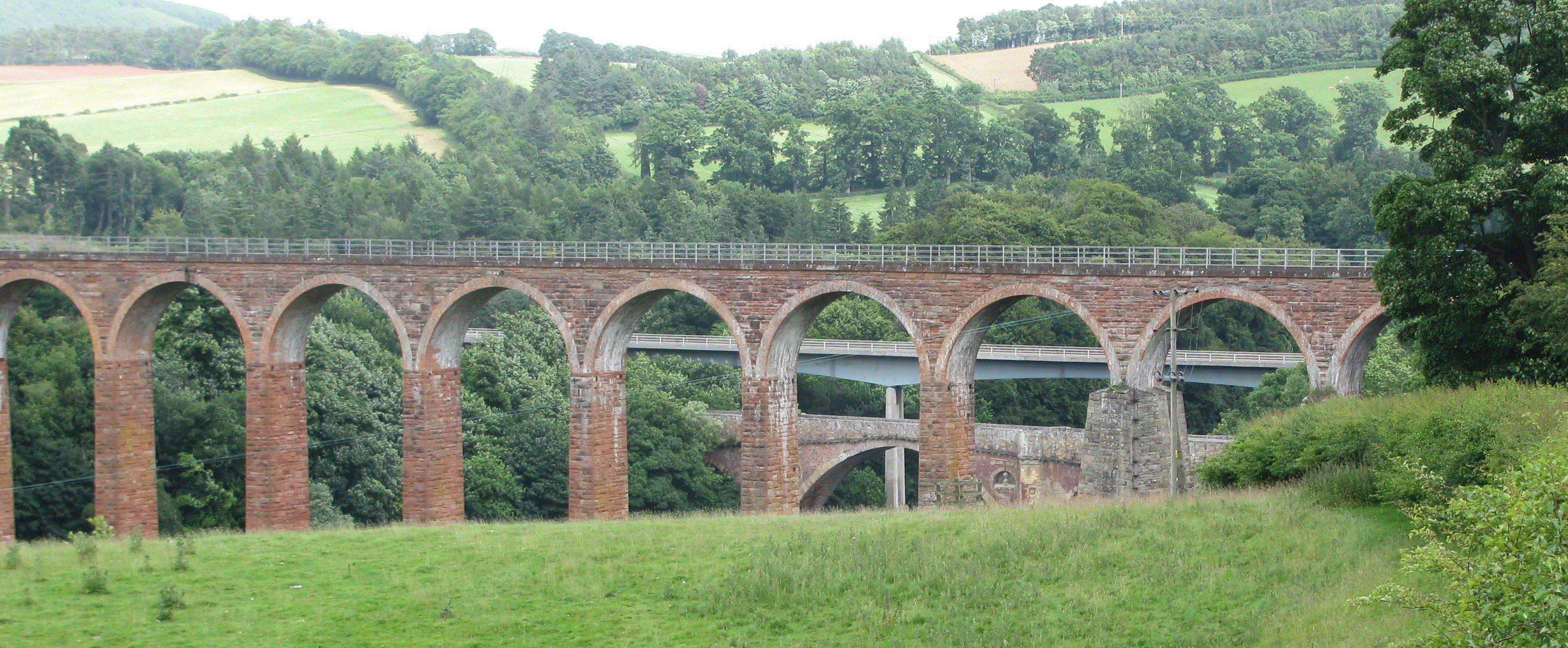
A roman fort also was at this spot and there was a bridge across the river at that time as well. There was also a ford near here. There is no need for bridges or fords unless people need to cross. What was here that people wanted? Was it just a way point to someplace else? I look around and all I see are fields. It probably hasn’t changed much since the Romans built an amphitheatre overlooking this river and people are still crossing this river.
Going where? Coming from where?
The more things change, the more they remain the same.
Social Media and me
Social media can be confusing since there are so many places one needs a presence. My daughter, Sarah, and I are working on stream lining my presence. As a result, I have gotten rid of one Facebook page and am going to direct everything to another Facebook page which I have renamed. What is amazing is that my snap in app, which updates Facebook with the new blog posting, was updated as well with the new name. I love it when computers talk to each other! Or they talk to much!
Water is …. by Nina Munteanu book launch
This was a unique book launch. There was a blessing/thanking of the Mimico Creek by a Mississauga Knowledge Holder, a presentation by Toronto and Region Conservation Authority on the Mimico Watershed, poetry reading, an introduction to the Watermarks Project, art and photographs spread about the room and an opportunity to talk to various interesting people brought together by Nina Munteanu.
All of it was in honour not just of Nina’s new book, but in honour of water. There is no doubt that water is under siege. The Mimico Creek watershed, in a heavily urbanised area, is just one example. Understanding of what rivers require to stay healthy has advanced significantly over the last 50 years. Where once the river was expected to run along man-determined paths, through man-determined structures replete with concrete and culverts, now they are being rehabilitated with plants, trees and naturally meandering paths, all designed to promote healthy water and the concomitant healthy ecosystem when water is clean. In selected areas of this creek, a lot of work has been done to try clean the heavily poluted Mimico Creek, including pulling out concrete and weirs, replanting with native species and attempting to re-route the river along its natural path.
Part of the problem is that government only sees the importance to something if it has some sort of benefit to its constituents, generally economic but not necessarily so. The Watermark project is an attempt to gather information about the significance of various body of waters into one place. As explained on www.watermarkproject.ca
- When you contribute a story to the archive, you register the waterbody in a national database of important waters.
- You document the value of that waterbody to you and your community.
- You help researchers identify waters where people swim, drink, or fish, so that those uses can be protected in the future.
- You provide evidence that ensures environmental laws can be used to safeguard your waters.
Identify, value, register – all critical pieces to keeping water, from small creeks through to large lakes healthy.
Social Media
Social media is both a boon to writers and an albatross around our necks. It allows us to connect with our readers and reach new readers – that’s the boon. It’s setting up the social media so that you can actually communicate with your readers – that’s the albatross.
I am wrestling with the linking of this blog with a second Facebook page. One of my Facebook pages links just fine. The second – well not so good. Oh well it’s all in a days work.
Water is…. by Nina Munteanu
My editor, Nina Munteanu, is publishing a new book, Water is …. and I’m going to her book launch. This is quite exciting because water is so very, very important. For years we have thought about water as a conduit – for fishes, for drinking, for recreational use. But over the past few years, it has become evident that it is critical to the life cycle for so much in the environment.
A few years ago, I went to a talk given by an Australian wine producer. It was an eye opener. The early Australian settlers had damned the run off from the spring rains. These rains brought heavy flooding with its concomitant damage and then the water disappeared. Australia is not a country blessed with the amount of water Canada has so it is understandable that they would try to store the water for use during their dry summers.
Oh, my was that a mistake. No one realised how important the spring run off was. Whole species of plant, animal and bird were driven to the edge. Reinstating the run off, breaking those damns, surprised everyone in the vineyard. In that short, wild, rushing time, trees, which everyone though dead, leafed out. Birds no one had seen in decades appeared, building nests and raising young. Animals which had been hiding popped their heads up and foraged happily. It was both a humbling lesson in how a reasonable desire to conserve water could wreck havoc on the environment and an inspirational lesson on how nature can crawl back from the edge, given the opportunity.
And all it took was to break the dams.